
Google Ads for Auto Detailers: How to Get Leads at $35 Each
Google Ads for auto detailing: a qualified lead costs $35. Here is how to structure campaigns in 2026 with broad match, Smart Bidding, and AI Max.

On this page
- Why Google Ads work for detailers
- Campaign structure: consolidated ad groups by service
- Keyword strategy: broad match with Smart Bidding is the default
- AI Max: the future of search campaigns
- Budget planning: what to spend
- Landing pages: why your homepage kills conversions
- Conversion tracking: measure booked jobs, not form fills
- Real case study: 87 leads in 30 days at half previous CPL
- Common mistakes I see (and how to avoid them)
- Frequently asked questions
A qualified detailing lead costs $35 on Google Ads for car detailing. Here is how to make sure you are not wasting a dollar of that in 2026. Whether you are a solo mobile detailer or a multi-service studio, Google Ads for auto detailing is the fastest way to put qualified leads on your calendar — if you treat it like a system, not a slot machine.
I have run Google Ads for detailing businesses across 12 US metros. The platform has changed fundamentally in the last two years. Broad match with Smart Bidding is now the default. Keywords are intent signals, not query filters. And AI Max is replacing dynamic search ads entirely. The shops that profit from ads in 2026 understand these changes. The shops that waste money are still running exact match only and wondering why they get no volume.
This guide covers exactly how to structure Google Ads for auto detailing in 2026: campaign setup, keyword strategy, budget planning, landing pages, conversion tracking, and the mistakes I see shops make over and over again. Whether you are a solo mobile detailer or a multi-service studio, this is the playbook I use for my own accounts. It also covers how to set up detailing marketing systems that feed into your ad campaigns. For a complete overview of auto detailing lead generation beyond just ads, see my detailing lead generation playbook.
Why Google Ads work for detailers
Google Ads work for detailing because the search intent is already there. Someone typing “ceramic coating near me” is not browsing. They are ready to buy. They have a car, they have a problem, and they are looking for a solution. Your job is to show up at that exact moment. This is why Google Ads for auto detailing outperform most other advertising channels for local service businesses.
Three reasons detailing ads outperform most local service businesses:
- High intent searches: “car detailing near me” has 133,000+ monthly searches in the US. These are not researchers. They are buyers with credit cards in hand.
- Visual proof advantage: before/after photos in ad extensions stop the scroll. Detailing is a visual service, and Google Ads let you show the work, not just describe it.
- Local targeting: you can target a 10-mile radius around your shop or service area. No wasted spend on people who will never drive to you.
Campaign structure: consolidated ad groups by service
The biggest mistake I see is either one campaign for everything OR one keyword per ad group. Both are wrong in 2026. Google now recommends 3 to 10 tightly themed ad groups per campaign. Each ad group should represent a distinct product category, service line, or intent cluster. Avoid creating separate ad groups for minor keyword variations.
Here is the structure I use for my detailing accounts:
| Campaign | Ad group theme | Budget split | Why |
|---|---|---|---|
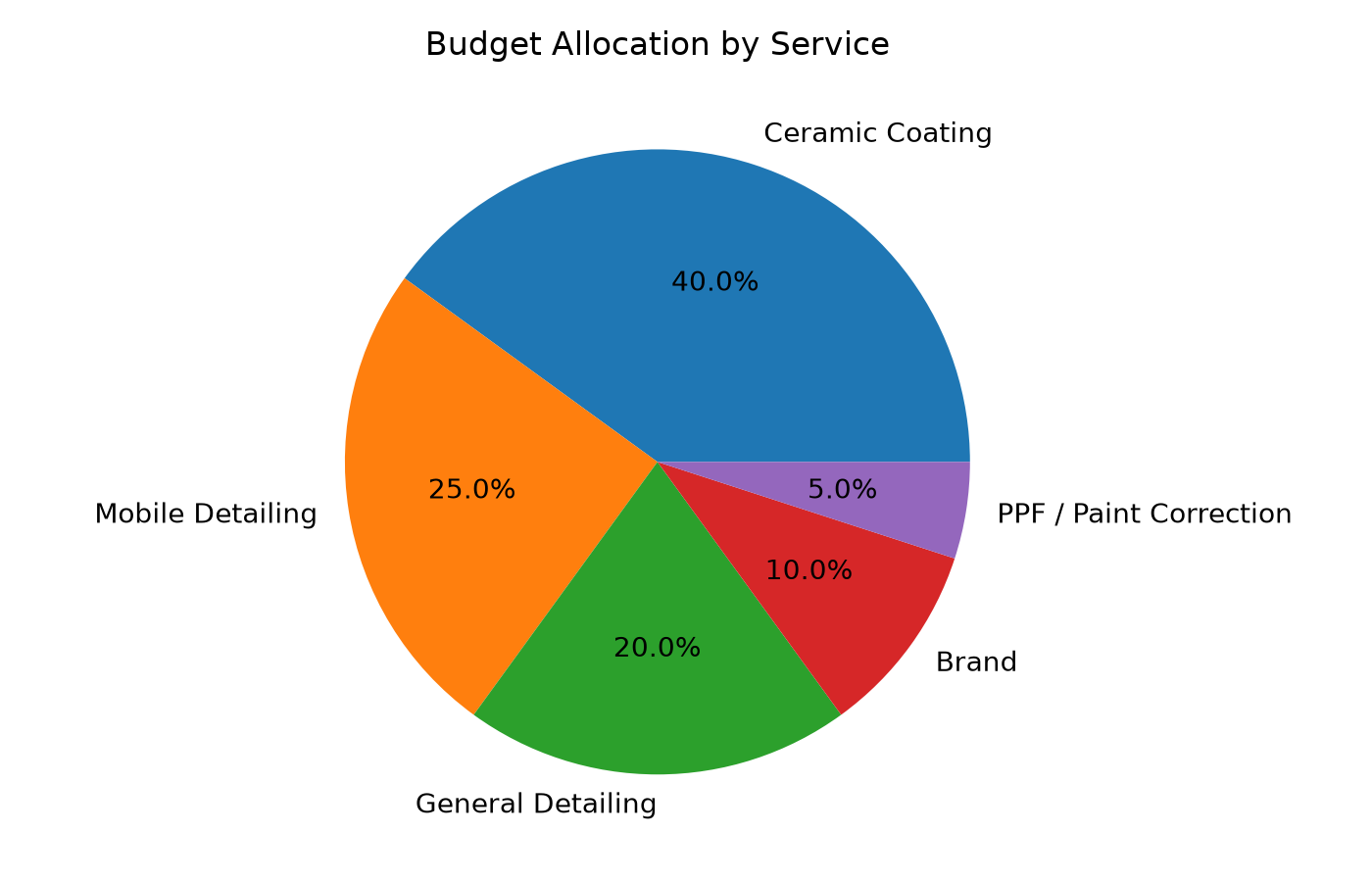
| Ceramic coating | Ceramic coating, paint protection, clear bra | 40% | Highest margin service, $1,000+ tickets |
| Mobile detailing | Mobile detailing, mobile car wash, on-site service | 25% | Growing 150%+ over 5 years, underserved |
| General detailing | Car detailing, auto detail, car cleaning | 20% | High volume, top of funnel |
| Brand | [Your business name], [your name] detailing | 10% | Protect your brand, cheap clicks |
| PPF/paint correction | PPF, paint correction, swirl removal | 5% | High ticket, low search volume |
How to split your budget
The biggest mistake I see is one campaign for everything. A ceramic coating searcher and a car wash searcher have very different intent and margins. Do not mix them.
Here is the budget split I recommend for a detailer spending $2,000/month:
Keyword strategy: broad match with Smart Bidding is the default
In 2026, keywords are an intent signal for the algorithm, not a precise query filter. Google’s own recommendation is broad match paired with Smart Bidding (target CPA or target ROAS). This is not what I would have told you two years ago. But the platform has fundamentally changed.
Here is what works now:
| Match type | When to use | Key detail |
|---|---|---|
| Broad match | Default for all campaigns | Pairs with Smart Bidding. Google finds relevant queries beyond your list. Requires strict negatives. |
| Phrase match | High-intent services | Captures variations while staying targeted. Works well for “ceramic coating near me” type queries. |
| Exact match | Brand terms only | Use for your business name and owner name. Do not use for service keywords. |
Important: broad match without Smart Bidding is where budgets go to die. Always pair broad match with target CPA or target ROAS. Never use maximize clicks bidding.
Negative keywords: your main control lever
Negatives are the only lever Google has left to the advertiser. With broad match expanding to queries you never imagined, your negative keyword list is what keeps budget inside searches that actually matter.
For detailing, these campaign-level negatives are non-negotiable:
- DIY, how to, tutorial, guide, learn
- Jobs, salary, career, hiring, employment
- Supplies, products, equipment, wholesale
- Free, cheap, discount, coupon
- Used cars, dealership, car sales
I maintain a negative keyword list of 200+ terms for every detailing account. It is the single highest-leverage optimization you can make.
AI Max: the future of search campaigns
AI Max for search is Google’s replacement for dynamic search ads. It automatically expands keywords, generates ad copy variations, and selects landing pages based on your existing content. Voluntary upgrades are available now, with automatic upgrades beginning September 2026.
For detailers, AI Max is powerful because it reads your landing page and finds queries you would never think to target. But it requires comprehensive negative lists. Without them, AI Max will show your ads for “how to detail a car yourself” and call it a match.
My recommendation: enable AI Max on your highest-performing campaign first. Monitor search terms weekly. Add negatives aggressively. Once you trust the system, roll it out to other campaigns.
Budget planning: what to spend
Google recommends 30 conversions/month for target CPA and 50 for target ROAS before judging results. For detailing, that means you need enough budget to generate at least 30 leads per month before the algorithm can optimize effectively.
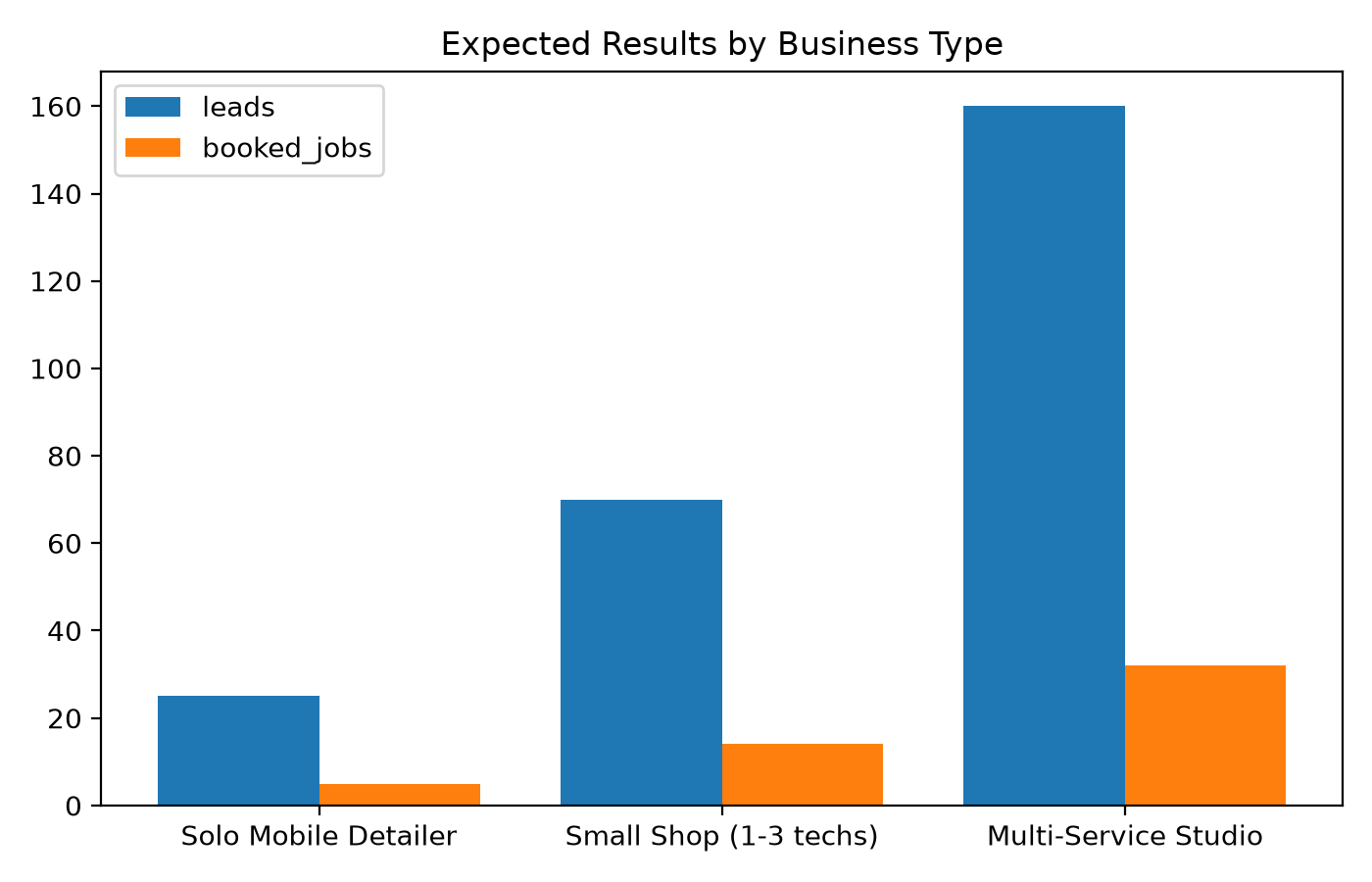
Here is a realistic budget framework based on my accounts:
| Business type | Monthly budget | Expected leads | Expected booked jobs |
|---|---|---|---|
| Solo mobile detailer | $800 - $1,200 | 20 - 30 | 4 - 6 |
| Small shop (1-3 techs) | $2,000 - $3,500 | 50 - 90 | 10 - 18 |
| Multi-service studio | $5,000 - $8,000 | 120 - 200 | 25 - 40 |
These numbers assume you are targeting ceramic coating and mobile detailing. General detailing keywords have lower CPC but also lower conversion rates. Adjust accordingly.
Reality check: if you are spending less than $800/month on Google Ads for detailing, you do not have enough data for Smart Bidding to optimize. You are flying blind. Start with at least $800 or wait until you can.
Landing pages: why your homepage kills conversions
Sending ad traffic to your homepage is the #1 conversion killer I see. A homepage is for everyone. A landing page is for one person with one problem.
Your ceramic coating ad should go to a ceramic coating page. Your mobile detailing ad should go to a mobile detailing page. The messaging must match the ad copy exactly. If your ad says “ceramic coating near me,” the landing page headline must say “ceramic coating in [city].” Not “welcome to our shop” or “we do everything.”
A high-converting detailing landing page has:
- Matching headline: repeats the exact search term
- Before/after gallery: 3-5 real jobs, not stock photos
- Social proof: review count, star rating, recent testimonials
- Clear pricing: starting at $x, packages listed, no “call for quote”
- Click-to-call button: mobile users should tap to call
- Booking form: name, phone, service needed, preferred date
Conversion tracking: measure booked jobs, not form fills
Most shops track “leads.” A lead is a form fill or a phone call. But not all leads are equal. A $50 wash lead and a $2,500 ceramic lead both count as “1 lead” in your reports. That is meaningless.
Track these conversions instead:
| Conversion | Value | Why it matters |
|---|---|---|
| Phone calls from ads | High | Immediate intent, books on the spot |
| Form submissions | Medium | Needs follow-up, may convert later |
| Booked jobs | Highest | This is what pays rent |
| Revenue per booked job | Critical | Tells you which keywords are profitable |
Set up call tracking (I use CallRail or Google forwarding numbers) so you know exactly which ad and which keyword generated each call. Without this, you are optimizing blind.
Real case study: 87 leads in 30 days at half previous CPL
A mobile detailer in Phoenix was spending $2,400/month on Google Ads for car detailing and getting leads at $78 each. They were about to shut it off. Here is what we changed:
- Consolidated campaigns: moved from 15 ad groups (one per keyword) to 5 ad groups (one per service category)
- Switched to broad match: paired with target CPA bidding at $45
- Added 200+ negatives: blocked “DIY,” “jobs,” “supplies,” “cheap,” “how to,” and competitor terms
- Built landing pages: one page per service, each with before/after photos and click-to-call
Results after 30 days:
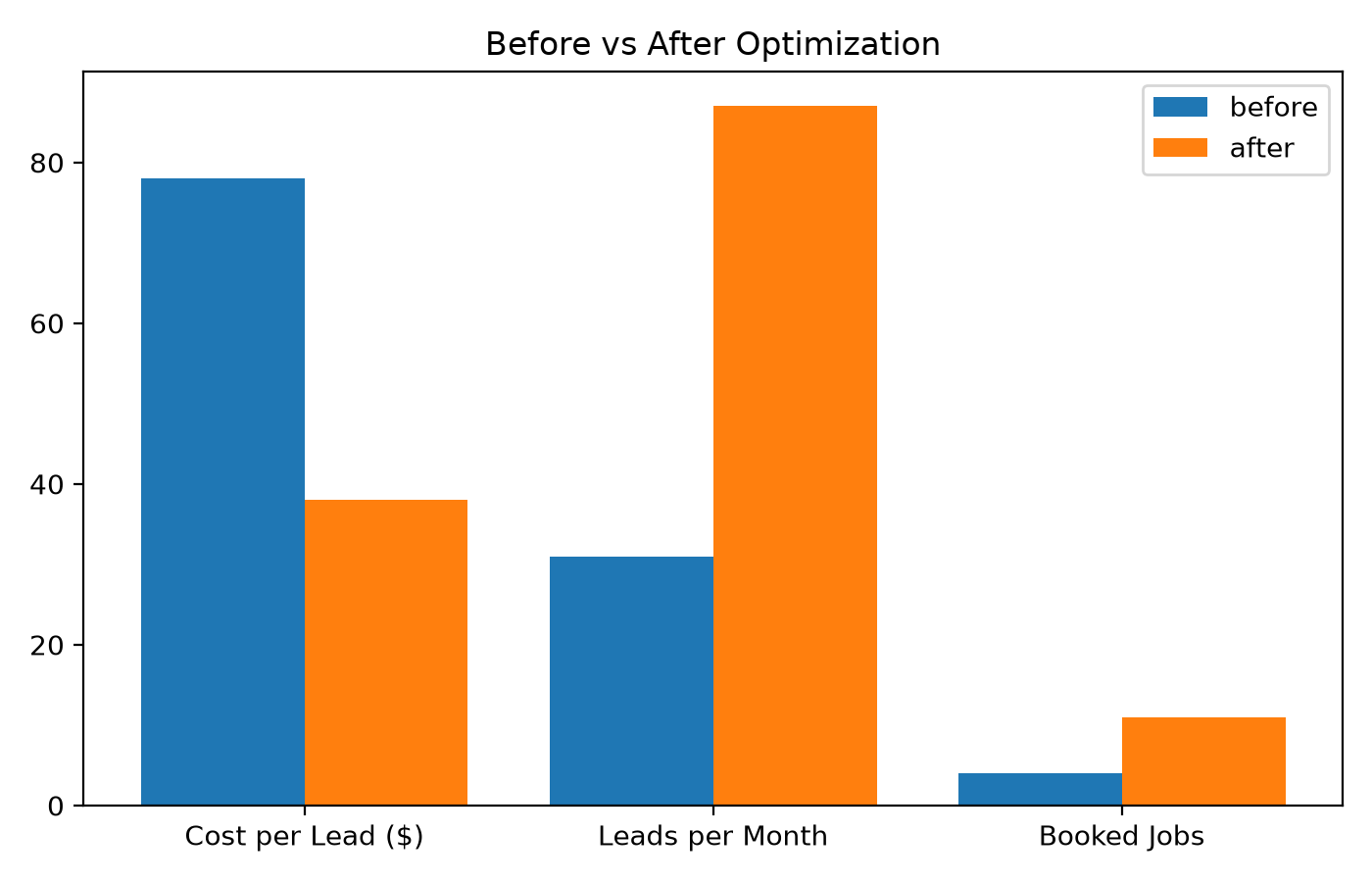
- 87 qualified leads (up from 31 previous month)
- $38 cost per lead (down from $78)
- 11 booked jobs at average $420 per job
- $4,620 revenue from $2,400 ad spend (1.9x ROAS)
The system worked because we stopped treating ads like a slot machine and started treating them like a measurable acquisition channel powered by Smart Bidding.
Common mistakes I see (and how to avoid them)
1. Exact match only
Exact match misses “close variants” and synonyms. In 2026, exact match for service keywords means you are leaving money on the table. Use broad match with Smart Bidding and negatives.
2. Homepage landing pages
Your homepage is for everyone. Your landing page is for one person. Match the page to the ad. Period.
3. Maximize Clicks bidding
This bidding strategy gets you the most clicks regardless of quality. Use target CPA or target ROAS. Smart Bidding evaluates each auction individually and bids based on likelihood to convert.
4. No call tracking
If you cannot attribute a call to a specific ad, you cannot optimize. Set up call tracking on day one.
5. Giving up too early
Google Ads need 30 conversions/month for Smart Bidding to optimize effectively. If you are spending $800/month, that is roughly 20-25 leads. Give it 60 days before judging results.
Frequently asked questions
How much should I spend on Google Ads for my detailing business?
Minimum $800/month for solo detailers, $2,000+ for shops. Below $800, you do not generate enough data for Smart Bidding to optimize. Google recommends 30 conversions/month for target CPA. The shops that commit to $2,000+/month consistently see 8-12% conversion rates from lead to booked job.
Should I use broad match keywords?
Yes, with Smart Bidding and strict negatives. In 2026, broad match is Google’s recommended default. It pairs with target CPA or target ROAS to find relevant queries beyond your keyword list. The key is a comprehensive negative keyword list (200+ terms for detailing).
What is a good cost per lead for detailing?
$25-$45 per qualified lead is typical. Ceramic coating leads cost more ($40-70) because search volume is lower but intent is higher. General detailing leads are cheaper ($15-30) but convert at lower rates. Track cost per booked job, not cost per lead.
How long before Google Ads start working for my shop?
Expect 30-60 days to optimize. Google needs 30 conversions/month for target CPA to work effectively. The first two weeks are data collection. Weeks 3-4 are optimization. By day 60, you should have a clear picture of which campaigns are converting. Do not judge results before day 30.
Should I run Google Ads or focus on SEO first?
Run both, but ads first for immediate results. SEO takes 3-6 months to compound. Google Ads generate leads on day one. Use ads to fill your calendar now while SEO builds. Once SEO kicks in, you can reduce ad spend gradually.
What is AI Max for search?
AI Max is Google’s replacement for dynamic search ads. It automatically expands keywords, generates ad copy variations, and selects landing pages based on your content. Voluntary upgrades are available now, with automatic upgrades beginning September 2026. Enable it on your highest-performing campaign first and monitor closely.
For more on building comprehensive auto detailing lead generation systems that go beyond Google Ads — including referral programs, B2B partnerships, and organic channels — read my detailing lead generation playbook. For a broader view of how to market a detailing business, that guide covers the full 7-strategy framework. And if you want to capture leads with quizzes and interactive funnels, see my first-party data lead gen guide.
Affiliate disclosure. Some links here are affiliate links. If you buy through them, I may earn a commission at no extra cost to you. Details.
I run Google Ads for lead-gen businesses and build the AI tooling that runs alongside them.